A Polymer Heat Exchanger transfers heat through polymer components rather than relying solely on conventional metal surfaces. Its appeal is clear in corrosive service, where chemical compatibility can matter more than maximum heat transfer per unit area. Yet “polymer” covers many materials, and their temperature, pressure, and chemical limits vary. The name alone tells you very little.
Common designs include shell-and-tube units, plate-style exchangers, and immersion coils or tube bundles. In shell-and-tube models, polymer tubes carry one fluid while another flows around them. Plate-style designs use shaped polymer surfaces to create compact flow paths, though construction and pressure limits depend on the specific product. Immersion coils sit directly in a tank, making them useful when process space is limited. Simple to picture. Not always simple to select.
The right type depends on the actual duty. Engineers should compare fluid chemistry, operating temperature, pressure, flow rate, fouling risk, cleaning methods, and available installation space. They should also review manufacturer data and confirm performance under realistic operating conditions. Polymer materials often have lower thermal conductivity than metals, so exchanger area and flow design deserve careful attention. That trade-off is easy to overlook.
No single configuration suits every plant. A unit that performs well in a mildly corrosive cooling loop may be unsuitable for a hotter, pressurized process. Even good specifications leave questions. Pilot testing or a detailed engineering review can expose them before installation. This guide examines the leading polymer exchanger types, their practical strengths, and the limits that should shape a sound choice.
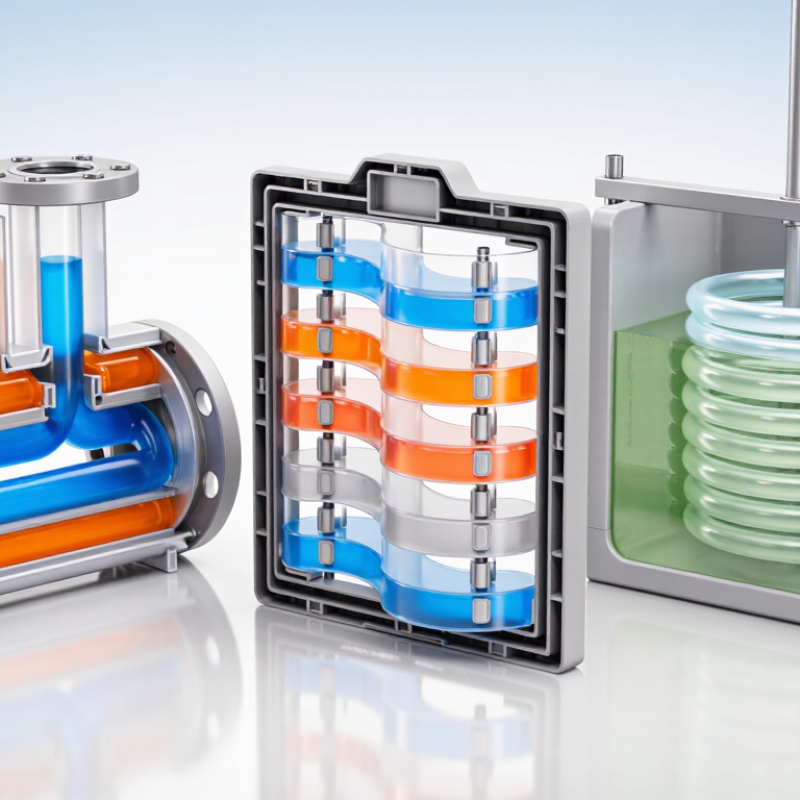
Polymer heat exchangers are commonly made from polypropylene, polyethylene, polyvinylidene fluoride, and fluoropolymers. Their low weight and resistance to corrosion suit cooling towers, chemical processing, and wastewater systems. The trade-off is heat transfer: unfilled polymers typically conduct heat at about 0.1–0.5 W/m·K, far below metals. MatWeb engineering-property records and the ASHRAE Handbook—Fundamentals provide reference values that vary by polymer grade and test conditions. Treat the range as a guide, not a guaranteed design value.
That modest conductivity makes wall thickness and surface area important. Thin tubes or plates can help, but they must still withstand pressure, temperature, and chemical exposure. Polymer heat exchangers may use tube bundles, plate structures, or hollow-fiber modules. Each geometry changes flow and fouling behavior. A material that performs well in a clean-water test may behave differently with deposits or viscous fluids. Small details matter.
Tips: Check the exact grade’s datasheet, then confirm conductivity at operating temperature. Ask for pressure and chemical-compatibility data, too. Leave room for uncertainty: published values do not capture every fabrication difference, and a prototype test may reveal issues calculations miss.
| Heat Exchanger Type | Typical Polymer Materials | Typical Material Thermal Conductivity | Construction and Operating Characteristics | Common Applications | Key Considerations |
|---|---|---|---|---|---|
| Shell-and-tube | Polypropylene (PP), polyethylene (PE), polyvinylidene fluoride (PVDF), or perfluoroalkoxy alkane (PFA) | PP: approximately 0.10–0.22 W/m·K; PE: approximately 0.35–0.50 W/m·K; PVDF: approximately 0.12–0.19 W/m·K; PFA: approximately 0.19–0.25 W/m·K | A bundle of polymer tubes carries one fluid while the second fluid flows through the surrounding shell. Tube dimensions and support design vary by duty. | Corrosive chemical service, acid recovery, plating lines, and industrial wastewater treatment | Useful where corrosion resistance is important. The low conductivity of many polymers can require more heat-transfer area than metal designs. |
| Plate-type | PP, PVDF, or fluoropolymer plates, depending on chemical compatibility and design | PP: approximately 0.10–0.22 W/m·K; PVDF: approximately 0.12–0.19 W/m·K; fluoropolymer grades: commonly about 0.15–0.25 W/m·K | Separate fluid passages are formed between polymer plates. Plate geometry and joining method depend on the exchanger design. | Corrosive process streams, chemical baths, and selected low-to-moderate-pressure duties | Thin walls and a large heat-transfer area can help offset low material conductivity. Pressure and temperature limits are design-specific. |
| Coil-type | PE, PP, PVDF, or fluoropolymers | PE: approximately 0.35–0.50 W/m·K; PP: approximately 0.10–0.22 W/m·K; PVDF: approximately 0.12–0.19 W/m·K | A continuous polymer tube is formed into a coil, with one fluid flowing inside the tube and another contacting its exterior. | Tank heating or cooling, chemical storage vessels, and corrosive liquid systems | Coil length, tube diameter, and fluid movement affect heat-transfer performance. Check polymer compatibility and mechanical support for the intended duty. |
| Immersion coil or tube bundle | PP, PVDF, or PFA, selected for the liquid and operating conditions | PP: approximately 0.10–0.22 W/m·K; PVDF: approximately 0.12–0.19 W/m·K; PFA: approximately 0.19–0.25 W/m·K | Polymer tubing or a tube bundle is immersed directly in a tank. A heat-transfer fluid circulates through the tubing. | Pickling and plating tanks, chemical baths, and corrosive process tanks | Provides direct heat exchange without exposing metal tubing to the bath. Immersion depth, fluid circulation, and tube support influence performance. |
| Hollow-fiber | Polypropylene, polyethylene, or fluoropolymer hollow fibers | Polymer fiber materials generally fall within approximately 0.10–0.50 W/m·K, depending on the resin and grade | Many small-diameter fibers provide a high surface-area-to-volume ratio. The two fluids flow on opposite sides of the fiber walls in designs suited to the application. | Compact systems, specialty process cooling, and selected gas–liquid or liquid–liquid duties | Small passages can be sensitive to fouling or blockage. Confirm pressure drop, cleaning requirements, and fluid compatibility for the specific module. |
Note: Thermal conductivity values are representative approximate ranges for unfilled bulk polymers near ambient conditions, not guaranteed product specifications. Actual values vary with resin grade, temperature, crystallinity, additives, and test method. Conductivity is a material property; exchanger performance also depends on wall thickness, flow conditions, fouling, and total heat-transfer area.
