Sorry, your browser is not supported. For a better experience, keep your browser up to date. Check here for latest versions
Choosing among China’s top 10 cigar display case manufacturers requires more than comparing prices. The right supplier should understand humidity control, wood stability, glass clarity, lighting, and daily retail use. These details influence both product protection and customer confidence. A well-built case should display cigars clearly while helping maintain a stable environment. It should also support lawful retail presentation and responsible product handling.
Michael Herklots, a respected cigar retailer and industry executive, has often emphasized that “presentation is part of the cigar experience.” That idea matters here. A warm LED glow, clean cedar interior, accurate hygrometer, and smoothly closing door can change how customers evaluate a collection. However, appearance alone is not enough. Manufacturers must provide consistent materials, documented quality procedures, dependable packaging, and responsive after-sales support. Factory experience also matters when buyers need custom dimensions, tempered glass, branded panels, or multiple humidity zones.
This guide reviews ten leading Chinese manufacturers from a practical purchasing perspective. It considers craftsmanship, customization, moisture management, production capacity, export experience, and value. Some suppliers may look impressive online but provide limited technical evidence. That is a warning sign. Buyers should request samples, material specifications, inspection photos, and clear warranty terms before placing a large order. Small mistakes, such as poor sealing or unstable hinges, can become expensive problems later. The ranking is therefore useful, but not absolute. Actual performance may change with configuration, climate, and maintenance.
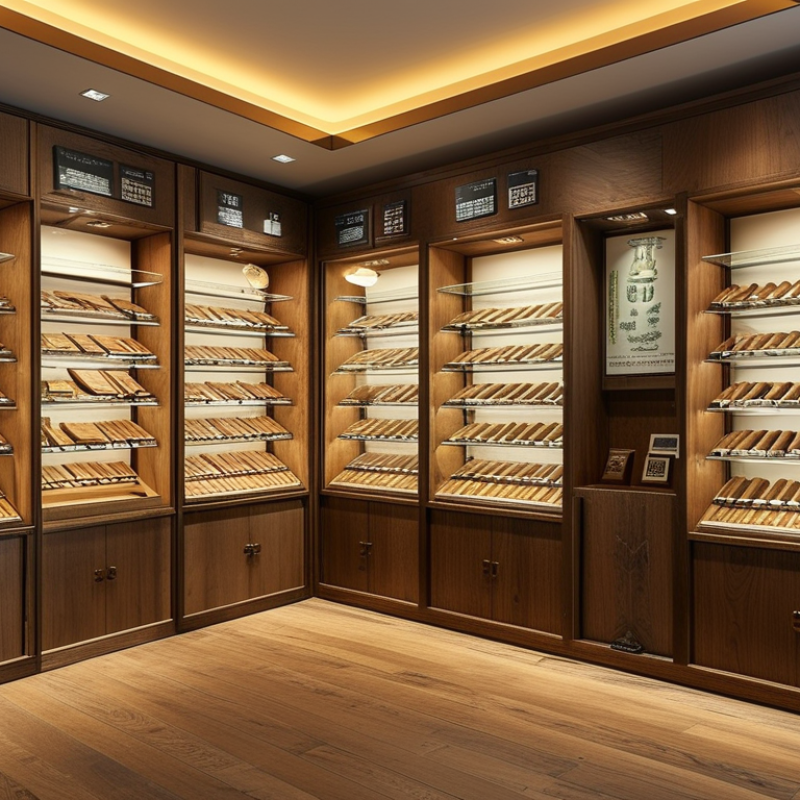
China Top 10 Cigar Display Case Manufacturers
China’s cigar display case market increasingly focuses on stable storage conditions, not appearance alone. A reliable case should maintain 65–70% relative humidity and 65–70°F. These ranges help reduce drying, swelling, and uneven aging in regulated tobacco products.
Manufacturers commonly use moisture-resistant wood, accurate hygrometers, magnetic seals, and adjustable ventilation. However, materials alone do not guarantee performance. A case placed near sunlight, heaters, or air conditioners may lose stability within hours. Factory testing should include humidity recovery, temperature variation, seal strength, and long-term power performance.
Quality inspection should also examine interior finishing and odor control. Strong adhesives or coatings can affect the storage environment. This detail is easy to overlook. Buyers should request calibration records and test data before comparing suppliers. A display case may show 68% RH on its screen, yet the reading can be wrong without sensor verification.
Experienced manufacturers usually provide clearer instructions for seasoning, cleaning, and routine monitoring. Their teams should understand both cabinet construction and environmental control. Still, no case performs perfectly in every climate. High coastal humidity, dry northern winters, and frequent door opening create different challenges. Regular checks remain necessary, even with advanced electronic controls.
| No. | Anonymized Manufacturer Segment | Typical Capacity | Recommended Relative Humidity | Recommended Temperature | Common Humidity System | Common Interior Material | Typical Application |
|---|---|---|---|---|---|---|---|
| 1 | Compact Desktop Display Case | 20–50 cigars | 65–70% RH | 65–70°F (18–21°C) | Passive humidification or electronic humidity module | Spanish cedar lining or cedar veneer | Home offices, desktops, and small collections |
| 2 | Medium Cabinet Display Case | 50–150 cigars | 65–70% RH | 65–70°F (18–21°C) | Digital humidity controller with fan circulation | Spanish cedar shelves and drawer components | Residential rooms and private lounges |
| 3 | Large Freestanding Cabinet | 150–300 cigars | 65–70% RH | 65–70°F (18–21°C) | Active humidification with calibrated digital control | Spanish cedar trays, shelves, or inserts | Collectors and premium residential interiors |
| 4 | Commercial Glass Display Cabinet | 300–600 cigars | 65–70% RH | 65–70°F (18–21°C) | Electronic humidification with continuous air circulation | Cedar shelving with tempered glass enclosure | Retail stores, tasting rooms, and hospitality venues |
| 5 | Temperature-Controlled Cabinet | 100–300 cigars | 65–70% RH | 65–70°F (18–21°C) | Thermoelectric cooling with electronic humidity control | Spanish cedar interior with removable shelves | Climates with seasonal temperature changes |
| 6 | Modular Wall-Mounted Display | 200–500 cigars | 65–70% RH | 65–70°F (18–21°C) | Centralized or zone-based electronic humidification | Cedar shelves with metal or engineered-wood framing | Clubs, lounges, and interior design projects |
| 7 | High-Capacity Walk-In System | 600–2,000 cigars | 65–70% RH | 65–70°F (18–21°C) | Dedicated HVAC and commercial humidification system | Spanish cedar wall panels, racks, and shelving | Specialty retailers and professional cigar rooms |
| 8 | Luxury Furniture-Style Display | 100–400 cigars | 65–70% RH | 65–70°F (18–21°C) | Hidden electronic control with low-noise fan | Cedar interior with wood veneer or solid-wood trim | Hotels, executive rooms, and premium residences |
| 9 | Portable Travel Display Case | 10–30 cigars | 65–70% RH | Ambient conditions; avoid temperatures above 70°F when possible | Humidity packs or sealed passive humidification | Cedar veneer, foam protection, and airtight seals | Travel, sampling, and short-term storage |
| 10 | Custom-Built Hospitality Display | 300–1,000 cigars | 65–70% RH | 65–70°F (18–21°C) | Multi-zone humidity and temperature monitoring | Spanish cedar components with commercial-grade glazing | Restaurants, resorts, bars, and cigar lounges |
Note: The figures represent common product specification ranges and storage standards used in the cigar display case market. The segments are anonymized and are not a ranking of individual companies or brands.
Evaluating China’s top 10 cigar display case manufacturers requires more than comparing prices. Examine the factory’s production experience, material control, and quality inspection process. Solid wood, tempered glass, reliable hinges, and stable humidity systems should meet clearly stated specifications. Ask for moisture readings, sealing tests, and photographs from actual production lines. A polished showroom can mislead.
Request a sample before placing a large order. Check the case for uneven joints, glass distortion, odor, loose hardware, and inaccurate temperature readings. Review production capacity, minimum order quantities, lead times, packaging methods, and replacement policies. Certifications may help, but verify their scope and validity. Speak with recent customers when possible. Their comments often reveal communication delays or inconsistent finishing.
Tips: Use a written evaluation sheet for every supplier. Compare identical specifications, not attractive quotations. Ask how rejected parts are recorded and corrected. Factory audits are useful, though one visit cannot prove long-term consistency. I would also test a sample through transport simulation, because a perfect case can arrive damaged. Do not judge craftsmanship from photos alone. Request video evidence, inspection records, and a clear warranty. Some manufacturers may answer confidently but avoid measurable details; treat that as a warning. Still, no evaluation method is flawless, and delivery performance can change with materials, staffing, or seasonal demand.
Spanish cedarremains a practical material for premium cigar display cases. Its porous structure helps buffer short humidity changes. It also adds a recognizable wood aroma. However, cedar alone cannot maintain stable conditions. Poorly seasoned boards may release moisture unevenly. That detail is often overlooked.
Glass provides visibility and supports retail presentation. Low-iron glass improves clarity under focused lighting. Steel adds strength, fire resistance, and reliable frame protection. Yet, steel conducts temperature quickly. Without insulation, condensation may appear near the glass. Grand View Research’s 2024 cigar and cigarillos market report identifies continued demand for premium presentation and storage solutions. This trend increases pressure on Chinese manufacturers to combine appearance with measurable performance.
Humidity control should be tested, not assumed. ASTM E104 provides a recognized method for maintaining controlled relative humidity during testing. Many storage specialists target approximately 65% to 72% relative humidity for cigar preservation. Digital sensors should record both humidity and temperature. A 2023 Mordor Intelligence market analysis also reports growing interest in smart monitoring across specialty storage products. Still, sensors can drift. Calibration checks matter. Some display cases look precise but lack airflow planning, removable reservoirs, or alarm functions. Manufacturers should document internal volume, testing duration, sensor accuracy, and material moisture content before shipment.
China Top 10 Cigar Display Case Manufacturers
Capacity should mean repeatable output, not a crowded factory floor. Ask each shortlisted manufacturer for monthly capacity, peak-season utilization, and available finishing lines. Small workshops may offer lower MOQs, but uneven humidity sealing can increase inspection costs. Larger facilities often improve consistency, yet custom tooling may require higher minimum orders. I would not treat the highest capacity as the safest choice.
Precision needs measurable proof. Request dimensional tolerances, hinge-cycle results, glass flatness, and internal humidity readings. The ISO Survey 2022 recorded 1,265,216 ISO 9001 certificates worldwide, showing the broad use of quality systems. However, certification alone proves little. Check the certificate scope, audit date, calibration records, and corrective-action history. For wooden components, FSC Facts & Figures 2023 reported more than 160 million hectares of certified forest globally. Ask for valid sourcing documents, not only printed claims.
Tips: Order three samples from separate production batches. Test lid alignment, seal compression, tray movement, and finish consistency. One sample can hide weak batch control. Compare MOQ against your real sales forecast, replacement needs, and packaging budget. A lower MOQ may reduce inventory risk, but it can raise unit cost and limit material choices. Include tolerance requirements in the purchase agreement. Samples are useful, but they are not the factory.
This anonymized benchmark compares ten Chinese cigar display case manufacturers using a normalized 0–100 index. Capacity reflects estimated production scale, precision reflects manufacturing and finishing consistency, certifications counts documented quality or compliance certifications, and MOQ is reverse-scored so that lower minimum order quantities receive higher values. The figures are intended for supplier screening and should be verified directly with each manufacturer.
Export readiness depends on more than attractive woodwork. Buyers should verify production lead times, customization control, packaging tests, and measurable quality records. A practical supplier often provides a clear timeline from drawing approval to shipment. Standard models may need 25 to 35 days. Custom orders can require 40 to 60 days. Always request a written schedule.
Customization should cover dimensions, wood species, glass type, hinges, locks, trays, and humidity components. A reliable factory confirms tolerances before cutting materials. It should also share sample photos, material certificates, and pre-production drawings. Details matter. One missed millimeter can affect door alignment. I have seen approvals delayed because the logo position was never fixed.
Export packaging deserves equal attention. Multi-layer cartons, corner protection, moisture barriers, and shock indicators reduce transit risks. Ask whether the factory performs drop tests or follows an agreed packaging standard. Quality data should include inspection checklists, defect rates, moisture readings, and final photographs. An AQL-based inspection can add useful discipline, but numbers alone prove little. Request recent records, not promises. A perfect schedule is rare. Weather, material shortages, and port congestion still create pressure, so a realistic buffer of seven to ten days is sensible. Suppliers that communicate problems early are usually safer partners than those offering impossible delivery dates.